9 Best Sticky Stabilizers for Embroidery (October 2026)
The best sticky stabilizers for machine embroidery include the HBI Peel and Stick Tear Away Roll for hard-to-hoop fabric, the Sulky Sticky Tear-Away 12 Inch Roll for cuffs and pockets, and the Sulky Sticky Clear Tear-Away Roll for clear positioning.
On this page (10 sections)
- How we chose sticky stabilizers for embroidery
- Sticky stabilizer options compared
- Sticky stabilizer for embroidery: which option fits each project?
- How do you choose sticky stabilizer for embroidery?
- What is the right setup for sticky stabilizer?
- How should you remove and care for sticky stabilizer?
- What mistakes should you avoid with sticky stabilizer?
- Is tear-away or wash-away sticky stabilizer better?
- Can sticky stabilizer prevent hoop marks?
- Clear decision: which sticky stabilizer should you choose?
The best sticky stabilizer for embroidery for most hard-to-hoop projects is HBI Peel and Stick Tear Away Roll. Its adhesive backing helps hold fabric that is awkward to hoop, and the tear-away format can be removed after stitching.
For washable work where you want the temporary backing to disappear, choose a water-soluble sheet or roll. If you're learning how stabilizer works with thread, needles and hoops, start with our beginner's guide to embroidery gear.
Our picks at a glance
-
1

-
2

-
3

- 4
 Check it
Stick N Stitch Wash Away Sheets
Best for reversible projects - 5
 Best for washable roll projectsCheck it
- 6
 Best for occasional small itemsCheck it
- 7
 Check it
FURWEY Sticky Water Soluble Sheets
Best for printed patterns - 8
 Check it
brothread Sticky Tear Away Roll
Best for repeat roll projects - 9
 Check it
Poolin Sticky Water Soluble Roll
Best for varied washable sizes
How we chose sticky stabilizers for embroidery
We compared backing type, adhesive setup, format and removal method against common embroidery needs. For hard-to-hoop fabric, adhesive tear-away material is a practical starting point; washable projects may suit a water-soluble option.
Rolls let you cut material for repeated or varied placements. Sheets are ready to use for small work, and printable sheets also help transfer a pattern.
Sticky stabilizer options compared
The main decision is whether you want backing that tears away or dissolves with water. Match that choice to the fabric's care needs, project size and support requirements.
| Product | Best for | Format | Removal | Weight | Our score |
|---|---|---|---|---|---|
| HBI Peel and Stick Tear Away Roll | hard-to-hoop fabric | 12 in x 10 yd roll | Tear away | Medium, 1.5 oz | 8.7 |
| Sulky Sticky Tear-Away 12 Inch Roll | cuffs and pockets | 12 in x 6 yd roll | Tear away | 8.4 | |
| Sulky Sticky Clear Tear-Away Roll | clear positioning | 8.25 in x 6 yd roll | Tear away | 8.3 | |
| Stick N Stitch Wash Away Sheets | reversible projects | 12 sheets, 8.5 x 11 in | Rinse away | 8.2 | |
| HBI Sticky Wash Away Roll | washable roll projects | 12 in x 5 yd roll | Dissolves in warm water | Medium, 1.5 oz | 8.0 |
| Sulky Sticky Plus Sheets | occasional small items | 12 sheets, 7.5 x 9 in | Tear away | 7.8 | |
| FURWEY Sticky Water Soluble Sheets | printed patterns | 12 sheets, 8.5 x 11 in | Rinse away | 7.5 | |
| brothread Sticky Tear Away Roll | repeat roll projects | 12 in x 10 yd roll | Tear away | Medium, 1.8 oz | 7.4 |
| Poolin Sticky Water Soluble Roll | varied washable sizes | 12 in x 10 yd roll | Dissolves in water | 7.2 |
Sticky stabilizer for embroidery: which option fits each project?
Choose from the options below by considering the item you're embroidering and how you'll finish it. Each product fills a distinct role, from a broad tear-away roll to printable wash-away sheets.
HBI Peel and Stick Tear Away Roll: Best for hard-to-hoop fabric
- 12 in x 10 yd roll
- Self-adhesive tear-away backing
- Medium 1.5 oz weight
A broad roll and adhesive backing suit projects where fabric is awkward to hoop. HBI says the stabilizer tears away after stitching with minimal residue.
Pros
- 12-inch width for larger placements
- Adhesive backing helps hold fabric during stitching
- Tear-away removal
Cons
- Not water resistant
- The adhesive format is given as sheet or pad
HBI's 12-inch roll gives you material for placements from small garment areas to wider fabric sections. Its adhesive backing is designed to hold fabric that cannot sit securely in a hoop.
HBI describes it as medium weight and says it tears away after stitching with minimal residue. The brand presents it for delicate, stretchy and standard fabrics; still, match support to your fabric and design density.
This is a tear-away product, so it isn't the right pick when the backing must dissolve. Choose a wash-away option below when the finished item can be rinsed and you want the temporary support removed that way.
Choose it for a broad, general-purpose adhesive tear-away roll. Our machine embroidery thread set guide covers beginner thread choices.
Sulky Sticky Tear-Away 12 Inch Roll: Best for cuffs and pockets
- 12 in x 6 yd roll
- Self-adhesive tear-away
- For small areas without basting
The wide roll can be used for pockets, cuffs, collars and other small areas. Sulky describes it as a non-woven stabilizer for computerized machine embroidery.
Pros
- Wide 12-inch roll
- Made for areas that are difficult to baste
- Can be used in or under the hoop
Cons
- Shorter roll than the 10-yard options
- Tears away, so it does not disappear like a wash-away stabilizer
Sulky Sticky Tear-Away suits small garment areas that are difficult to baste, including pockets, edges, button rows, ribbon, cuffs and collars. Adhesive holds those pieces in place while you stitch.
The 12-inch-wide, 6-yard roll uses a paper-backed release sheet. Sulky's instructions describe hooping the sheet with the stabilizer, scoring the paper where needed, peeling it back and pressing the fabric onto the exposed adhesive.
Sulky names knit fabric, velvet, sweatshirts and fleece among its intended materials. It tears away after stitching, so remove it gently around delicate stitches.
Choose it for repeated work on cuffs, collars and pockets. If you prefer to hold fabric with a hoop, compare that setup with our guide to magnetic embroidery hoops.
Sulky Sticky Clear Tear-Away Roll: Best for clear positioning
- Clear stabilizer
- 8.25 in x 6 yd roll
- Self-adhesive tear-away
The clear material offers a less visible backing while you position fabric for stitching. Sulky highlights small areas such as pockets, cuffs, collars and ribbon.
Pros
- Clear material
- Self-adhesive backing
- Designed for small or hard-to-hoop areas
Cons
- Narrower than the 12-inch roll
- Shorter than the 10-yard rolls
The Sulky clear roll is useful when you want backing that is less visible during positioning. It's narrower and shorter than the 12-inch, 10-yard options, which makes it a better fit for smaller placements than broad, repeated work.
Sulky describes it for computerized machine embroidery and highlights pockets, cuffs, collars and ribbon. It can be used in or under the hoop, and Sulky says this approach can help avoid hoop marks.
It is still tear-away material, so it won't dissolve after stitching. Remove it carefully around narrow satin stitches and other delicate details.
Choose it for small projects where clear material helps with positioning. If visibility isn't a concern, compare it with our tear-away stabilizer picks.
Stick N Stitch Wash Away Sheets: Best for reversible projects
- 12 sheets, 8.5 x 11 in
- Self-adhesive and water soluble
- Can be used as a topper or backing
These printable, fabric-like sheets suit projects where you want temporary adhesive placement and no stabilizer left on either side after rinsing. Sulky describes uses that include hand embroidery, punch needle, cross stitch and quilting.
Pros
- Wash-away material
- Useful as a topper or backing
- Sheet format is easy to cut
Cons
- Sheets provide less continuous material than a roll
- Rinsing is required for removal
Stick N Stitch combines a self-adhesive surface with water-soluble material in 8.5 x 11-inch sheets. Its printable, fabric-like surface suits a design you want to print or draw, stick in place, then rinse away.
Sulky describes it for use as a topper or backing, and for hand embroidery, punch needle, cross stitch and quilting. When rinsed away, no stabilizer remains on either side, which suits reversible projects.
Sheets take more preparation than a roll for repeated large placements, but they're easy to cut for a single design. Check that the fabric can be rinsed before you stitch, especially if the finished item needs special care.
Choose these sheets for washable projects and pattern transfer. They suit a maker who wants a temporary design surface as well as adhesive placement.
HBI Sticky Wash Away Roll: Best for washable roll projects
- 12 in x 5 yd roll
- Water-soluble adhesive and base
- Medium 1.5 oz weight
The water-soluble backing and adhesive are intended to dissolve in warm water, making this a fit for washable projects. HBI describes it for low to medium stitch density.
Pros
- Wide 12-inch roll
- Both base and adhesive dissolve in warm water
- Can be used as a topper
Cons
- Requires water for removal
- Not a permanent backing
HBI Sticky Wash Away pairs a 12-inch width with a water-soluble base and adhesive. HBI says both dissolve in warm water, so this roll fits washable projects where you want the temporary support to rinse out.
The roll is 5 yards long and medium weight. HBI describes it for low to medium stitch density, free-standing lace, appliqué, quilting and use as a topper to limit stitch show-through on textured fabric.
Plan the finish around washing: the stabilizer needs water to dissolve, and the garment must be suitable for rinsing. This isn't a permanent backing for a project that needs lasting support.
Choose this roll for washable embroidery with low to medium stitch density. Skip it for non-washable fabric or when the design needs lasting support.
Sulky Sticky Plus Sheets: Best for occasional small items
- 12 self-adhesive tear-away sheets
- 7.5 x 9 in sheets
- For cuffs, collars, pockets and socks
The sheet pack suits occasional small placements without measuring a section from a roll. Sulky lists cuffs, collars, pockets, socks, ribbons and several fabric types among its uses.
Pros
- Ready-to-use sheet format
- Self-adhesive for small items
- Tear-away removal
Cons
- Smaller sheets limit placement size
- Tear-away material remains a different choice from rinse-away backing
Sulky Sticky Plus Sheets provide pre-cut pieces for small placements. Each sheet measures 7.5 x 9 inches, so you can prepare a cuff, pocket or sock without cutting material from a roll.
Sulky describes the sheets as self-adhesive tear-away stabilizer for computerized machine embroidery. The material is cellulose with an acrylate coating; Sulky's instructions describe hooping it paper-side up, scoring the paper, then pressing fabric onto the exposed adhesive.
The sheet size works for occasional small work, but broad placements may need a larger piece or roll. Pull the backing away gently after stitching.
Choose these sheets when you embroider small items now and then. For thread choices, see our embroidery bobbin thread guide.
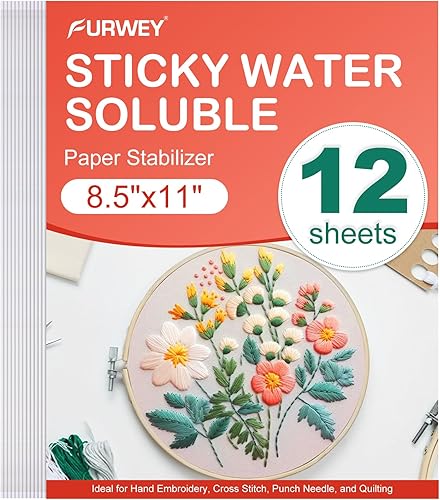
FURWEY Sticky Water Soluble Sheets: Best for printed patterns
- 12 sheets, 8.5 x 11 in
- Self-adhesive and printable
- Rinses away in cold or warm water
Printable, self-adhesive sheets help transfer a drawn or printed pattern while holding fabric in place. FURWEY describes the sheets for both hand and machine embroidery.
Pros
- Printable sheet format
- Water-soluble material
- Can be used on top or underneath a design
Cons
- Rinsing is needed after stitching
- Sheet format may be less convenient for repeated large placements
FURWEY's 8.5 x 11-inch sheets have one-sided adhesive and a printable surface for pattern placement. FURWEY says they rinse away in cold or warm water and describes them for hand and machine embroidery, needle punch, cross stitch and quilting.
The brand names small placements such as pockets, cuffs, collars, socks and doll clothes. It also describes the sheets for textured fabrics including velvet, flannel and fleece.
Use the printable format when a drawn or printed pattern helps you place the design. Since the material is meant to wash away, make sure the finished fabric can be rinsed.
Choose these sheets for small washable designs you want to print or draw first. Skip them for non-washable items or projects where the backing needs to remain.
brothread Sticky Tear Away Roll: Best for repeat roll projects
- 12 in x 10 yd roll
- Medium weight, 1.8 oz
- For fabric that is difficult to hoop
This 10-yard roll is intended for hard-to-hoop items such as towels, cuffs, collars and pockets. New brothread says it suits light to medium stitch density.
Pros
- Long 12-inch roll
- Adhesive backing for hard-to-hoop fabric
- Can be supplemented with ordinary tear-away backing
Cons
- New brothread notes temperature can affect adhesion
- Dense designs may need added support
New brothread's 12-inch-wide, 10-yard roll gives you a longer tear-away option for hard-to-hoop fabric. The brand names towels, cuffs, collars, socks, doll clothes, edges and pockets as possible placements without basting.
New brothread describes the material as medium weight for light to medium stitch density. For denser designs or unstable fabric, it suggests floating a square of regular tear-away stabilizer between the hoop and machine bed for added support.
The brand also notes that temperature and environment can affect adhesion. In a cold, wet space, check that the stabilizer holds before starting the design.
Choose this roll for repeated hard-to-hoop work when you want 10 yards of tear-away material. Skip it for dense designs unless you're prepared to add the extra backing support New brothread recommends.
Poolin Sticky Water Soluble Roll: Best for varied washable sizes
- 12 in x 10 yd roll
- Water-soluble paper stabilizer
- Can be cut to fit a design
The continuous roll can be cut for small or large designs, while its water-soluble format is intended to rinse away. Poolin says it is not for permanent backing, heavy-duty stabilization or non-washable projects.
Pros
- Long roll can be cut to size
- Water-soluble removal
- Designed for hard-to-hoop areas
Cons
- Not intended for non-washable projects
- Not a permanent or heavy-duty backing
Poolin's 12-inch-wide, 10-yard roll is a water-soluble option that you can cut to fit each design. Poolin describes it for hand and home machine embroidery, appliqué and crafts, including hard-to-hoop areas such as collars and hats.
The backing is intended to dissolve in water after stitching. Poolin says it isn't for permanent backing, heavy-duty stabilization, fusible interfacing or non-washable projects, so plan to rinse the finished item.
A continuous roll helps if you need different sizes for a batch of washable pieces. Choose a tear-away product when the fabric cannot be rinsed or needs support that lasts.
Choose this roll for varied-size washable placements and repeated cutting. Skip it when the project is non-washable or needs heavy-duty, lasting support.
How do you choose sticky stabilizer for embroidery?
Choose sticky stabilizer by the fabric, placement, stitch density and removal method. Tear-away backing suits projects where you can remove the stabilizer gently; water-soluble backing fits washable items where you want the temporary material to dissolve.
For a small or bulky item such as a cuff or pocket, adhesive can hold fabric without basting it to the backing. For a wider design, check that the roll provides enough width and that the design doesn't need extra support.
A high-pile or textured surface may need a topper to keep stitches from sinking into the fabric. If your project needs support that remains after stitching, use an appropriate permanent stabilizer instead of a wash-away option.
What is the right setup for sticky stabilizer?
Set up the stabilizer according to its format and the product's directions. For adhesive tear-away with a paper release sheet, one method is to hoop the stabilizer with the paper side up, score the paper, peel away the section and press the fabric onto the exposed adhesive.
For other products, cut the needed piece, expose the adhesive and attach the fabric as directed. Keep the needle path clear of loose paper, excess adhesive and unsecured fabric before you begin stitching.
Some products can be hooped with the stabilizer, while others can be attached to the hoop so fabric rests on the adhesive. Follow the instructions for your specific stabilizer and machine; the setup can differ by material and hoop.
How should you remove and care for sticky stabilizer?
Remove tear-away backing slowly, working from the edges and supporting the fabric near the design. Pulling sharply can put strain on stitches, especially at small details.
Rinse water-soluble stabilizer as directed until it dissolves. Use that method only when the fabric and thread can handle rinsing, and let the item dry as its care needs allow.
Store unused material flat or rolled as appropriate for its format, with adhesive covered by its release paper. Keep the sticky surface clean so lint and dust don't interfere with adhesion.
What mistakes should you avoid with sticky stabilizer?
The first mistake is choosing by adhesive alone and ignoring removal. A wash-away stabilizer isn't suitable for a non-washable project, and tear-away won't disappear just because you want a clean back.
The second is asking a lightweight or medium stabilizer to support a design it isn't intended for. HBI describes its wash-away roll for low to medium stitch density, while New brothread recommends extra ordinary tear-away support for denser stitching or unstable fabric.
Don't let the release paper or excess stabilizer enter the stitch path. Also, avoid stretching the fabric as you press it onto the adhesive; keep it smooth and positioned as the design requires.
Is tear-away or wash-away sticky stabilizer better?
Tear-away is better when the finished piece shouldn't be rinsed and you can remove the backing without harming the fabric. Wash-away is better when the fabric can be rinsed and you want the temporary material to dissolve.
Check the garment care label before choosing a water-soluble backing. If the fabric can't be washed, choose a compatible tear-away or another stabilizer type that can be removed safely.
Can sticky stabilizer prevent hoop marks?
Sticky stabilizer lets you attach fabric without hooping it directly, which may help avoid hoop marks on some materials. Sulky describes its Sticky Plus options for use in or under a hoop to avoid hoop marks.
The result depends on the fabric, hoop and setup. If the fabric already sits securely in the hoop without marking, standard backing may be simpler.
Clear decision: which sticky stabilizer should you choose?
Choose HBI Peel and Stick Tear Away Roll for a broad, general-purpose adhesive tear-away roll. Pick Sulky Sticky Tear-Away for repeated cuff, collar and pocket work, or its clear roll when less-visible material helps with positioning.
For washable work, choose Stick N Stitch sheets when pattern transfer or reversible use matters, HBI Sticky Wash Away for a medium-weight roll, or Poolin for varied-size cuts from a longer roll. Match the removal method to fabric care, then see our tear-away embroidery stabilizer guide if your project calls for ordinary backing.
Our top 3 picks at a glance
-
1
-
2
-
3
Frequently asked questions
What is sticky stabilizer for embroidery?
Sticky stabilizer has an adhesive surface that holds fabric in place during stitching. Tear-away versions are removed by pulling away the backing after embroidery, while water-soluble versions are rinsed away.
Choose the removal type based on the fabric and whether you can wash the finished item.
When should you use sticky stabilizer?
Use sticky stabilizer when an item is too small, bulky or delicate to hoop easily, such as a cuff, pocket or towel. The adhesive holds the fabric in place while you stitch.
For general backing choices, see our guide to tear-away embroidery stabilizers.
Should you choose tear-away or wash-away sticky stabilizer?
Choose tear-away when you can remove the backing by gently tearing it after stitching. Choose wash-away when the finished fabric can be rinsed and you want the temporary stabilizer to dissolve.
Check the garment's care needs before using a water-soluble option.
Can sticky stabilizer prevent hoop marks?
It can help you avoid placing the fabric directly in the hoop, which may reduce hoop marks on some materials. Sulky describes its Sticky Plus options for use in or under a hoop to avoid hoop marks.
The best setup depends on the fabric, hoop and design.
Can sticky stabilizer be used with any embroidery design?
No single sticky stabilizer fits every design. Stitch density, fabric stretch, pile and washability all affect the backing choice.
For denser stitching, the stabilizer maker may recommend extra support, so check the material guidance and test your setup on a similar fabric scrap.